A Kasparov Moment for Pure Mathematics? Inside OpenAI's Navier–Stokes Breakthrough and the Debate It Ignited
Earlier this week, a headline sent shockwaves across both the technology sector and academia: OpenAI claimed its AI systems solved one of mathematics’ most legendary challenges: the Navier–Stokes existence and smoothness problem. As one of the seven Millennium Prize Problems designated by the Clay Mathematics Institute, the Navier–Stokes equations have stumped fluid dynamicists and mathematicians for generations.
Yet, as details of the announcement emerged, the milestone sparked not just celebration, but a fierce debate over attribution, compute-driven research, and the future of scientific discovery.
The Challenge: When Fluids “Blow Up”
Formulated over a century and a half ago, the Navier–Stokes equations govern how fluids (liquids and gases alike) flow. From weather forecasting and aerodynamics to cardiovascular medicine, these equations form the bedrock of modern fluid mechanics.
Despite their ubiquitous utility, mathematicians have never proved whether smooth, physically sensible solutions always exist in three dimensions under all initial conditions. The core question: can fluid flow accelerate to infinite velocity and cause the equations to break down in finite time?
OpenAI’s preprint reported that its autonomous agent swarm successfully demonstrated that the equations do indeed develop finite-time singularities, effectively proving that the classical smooth solutions can break down.
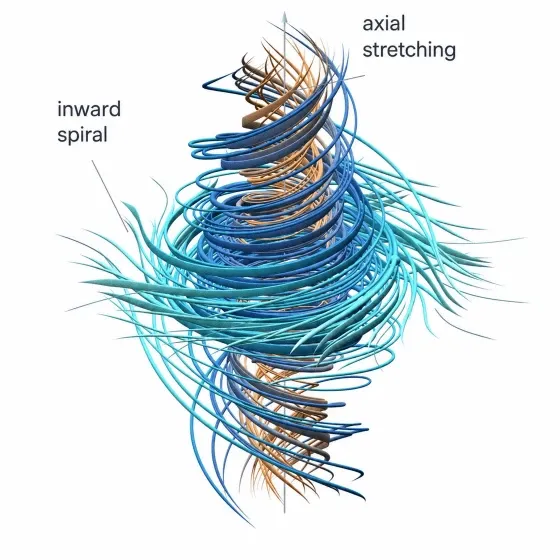 A complex vortex structure key to solving the Navier–Stokes existence and smoothness problem. Image courtesy of OpenAI.
The Method: Swarms and Brute-Force Reasoning
Unlike traditional mathematical breakthroughs, which usually emerge from lone scholars or small research partnerships filling blackboards, OpenAI’s solution was powered by unprecedented computational scale:
- Massive agent architecture: Approximately 10,000 autonomous AI agents collaborated continuously across an estimated 88 hours.
- Intense compute burn: The run consumed millions of dollars in compute, coordinating millions of messages to search for and verify vortex breakdown geometries.
- Formal verification: Portions of the logic were tested and cross-verified using automated reasoning environments to ensure structural rigour.
OpenAI notably announced that it would decline the $1 million Clay Millennium Prize, underscoring that for frontier AI labs, the true reward is benchmarking cognitive capability rather than prize money.
The Controversy: Provenance and Academic Credit
Almost immediately following the announcement, the accomplishment became embroiled in a credit dispute. Tristan Buckmaster, a mathematics professor at New York University, along with Levent Alpöge of Anthropic, had already been deep into research tackling the very same problem, often utilising AI coding and reasoning assistants to formulate drafts of their proofs.
Buckmaster raised concerns that the rapid deployment of OpenAI’s swarm may have leveraged or been triggered by knowledge of their work-in-progress, questioning data provenance and whether user interactions with AI tools inadvertently feed competitive lab releases.
While OpenAI denied copying their methodology and noted that the project was inspired by industry rumours of an imminent breakthrough, the company acknowledged that data from previous interactions could not be entirely ruled out from model training sets. The clash highlights a growing friction point: when proprietary foundation models ingest human scientific progress, where does human scholarship end and machine innovation begin?
What Comes Next?
Before OpenAI’s solution enters the mathematical canon, several crucial steps remain:
- Rigorous peer review: Millennium Prize solutions require exhaustive scrutiny by the global mathematics community, a process that typically takes months or years.
- Interpretability: Pure mathematics values the why as much as the what. A verified singularity proof must yield conceptual understanding that human mathematicians can dissect, teach, and build upon.
- Redefining the craft: As Fields Medallist Terence Tao and other leading thinkers have noted, AI’s entry into frontier mathematics doesn’t render human insight obsolete; instead, it reframes the mathematician’s role from raw calculation to high-level architecture, problem formulation, and verification.
Whether viewed as a historic leap forward or an industrial compute showcase, OpenAI’s announcement marks an undeniable turning point. The frontier of abstract discovery is no longer the sole domain of human thought.